Thursday, 29 September 2011

St Michael the Archangel

.

Four times is the name of St Michael recorded in Scripture:

(1) Daniel 10: 13 sqq., Gabriel says to Daniel, when he asks God to permit the Jews to return to Jerusalem: "The Angel [D.V. prince] of the kingdom of the Persians resisted me . . . and, behold Michael, one of the chief princes, came to help me . . . and none is my helper in all these things, but Michael your prince."

(2) Daniel 12, the Angel speaking of the end of the world and the Antichrist says: "At that time shall Michael rise up, the great prince, who standeth for the children of thy people."

(3) In the Catholic Epistle of St Jude: "When Michael the Archangel, disputing with the devil, contended about the body of Moses" etc. St Jude alludes to an ancient Jewish tradition of a dispute between Michael and Satan over the body of Moses, an account of which is also found in the apocryphal book on the assumption of Moses (Origen, De Principiis III.2.2). St Michael concealed the tomb of Moses; Satan, however, by disclosing it, tried to seduce the Jewish people to the sin of hero-worship. St Michael also guards the body of Eve, according to the "Revelation of Moses" ("Apocryphal Gospels" etc., ed. A. Walker, Edinburgh, p. 647).

(4) Apocalypse 12: 7: "And there was a great battle in heaven, Michael and his angels fought with the dragon." St John speaks of the great conflict at the end of time, which reflects also the battle in heaven at the beginning of time. According to the Fathers there is often question of St Michael in Scripture where his name is not mentioned. They say he was the cherub who stood at the gate of paradise, "to keep the way of the tree of life" (Genesis 3:24), the angel through whom God published the Decalogue to his chosen people, the angel who stood in the way against Balaam (Numbers 22: 22 sqq.), the angel who routed the army of Sennacherib (2 Kings 19: 35). Following these Scriptural passages, Christian tradition gives to St Michael four offices:

To fight against Satan.

To rescue the souls of the faithful from the power of the enemy, especially at the hour of death.

To be the champion of God's people, the Jews in the Old Law, the Christians in the New Testament; therefore he was the patron of the Church, and of the orders of knights during the Middle Ages.

To call away from earth and bring men's souls to judgment ("signifer S. Michael repraesentet eas in lucam sanctam", Offert. Miss Defunct. "Constituit eum principem super animas suscipiendas", Antiph. off. Cf. The Shepherd of Hermas, Book III, Similitude 8, Chapter 3).

In the Roman Catholic calendar of saints, Anglican calendar of saints, and the Lutheran calendar of saints, his feast day, once widely known as Michaelmas, is celebrated September 29th.


There is a legend in Cornwall that in the 5th century, the Archangel appeared to fishermen on St Michael's Mount.

Also a Portuguese Carmelite nun, Antónia d'Astónaco, had reported an apparition and private revelation of the Archangel Michael who had told to this devoted Servant of God, in 1751, that he would like to be honored, and God glorified, by the praying of nine special invocations. These nine invocations correspond to invocations to the nine choirs of angels and origins the famous Chaplet of Saint Michael. This private revelation and prayers were approved by Pope Pius IX in 1851.

During the years 1961 to 1965, four young schoolgirls had reported several apparitions of Saint Michael the Archangel in the small village of San Sebastian de Garabandal, in Cantabria, north Spain. At Garabandal, the apparitions of the Archangel Michael were mainly reported as announcing the arrivals of the Virgin Mary. The Catholic Church has never condemned Garabandal apparitions, and the Vatican has never made an official pronouncement.

The name of this Archangel means "who is like unto God?" In the Old Covenant he is made known to us as the "great prince," the protector of the children of Israel (Dan. 12, 1). Through the New Testament the Church continues this patronage of Michael (Apoc. 12, 7) and has always venerated him as the guardian angel of the kingdom of Christ on earth, as the heavenly leader in the fight against all enemies of God.

His feast, originally combined with the remembrance of all angels, had been celebrated in Rome from the early centuries on September 29th. The Synod of Mainz (813) introduced it into all the countries of the Carolingian Empire and prescribed its celebration as a public holiday. All through medieval times Saint Michael’s Day was kept as a great religious feast (in France even up to the last century) and one of the annual holiday seasons as well. The churches of the Greek Rite keep the feast on November 8th, and a second festival on September 6th. In France the apparition of the Archangel at Mont-Saint-Michel is commemorated on October 16th. Another apparition, on Mount Gargano in Apulia, Italy, is honoured by a memorial feast in the whole Western Church on May 8th.

The great Archangel is not only protector of the Christians on earth but of those in purgatory as well. He assists the dying, accompanies the souls to their private judgment, brings them to purgatory, and afterward presents them to God at their entrance into Heaven. Thus he is the actual patron of the holy souls. As Satan is "ruler" in hell so Michael is the "governor" of Heaven (Praepositus Paradisi) according to ancient books. The Church expresses this patronage in her liturgy. In the Offertory prayer of the Requiem Masses she prays:

Sed signifer sanctus Michael repraesentet eas in lucem sanctam, quam olim Abrahae promisisti et semini eius.

Saint Michael, the banner bearer, may conduct them into the holy light which Thou hast promised to Abraham and his seed.

Saint Michael’s protection over holy souls is also the reason for dedicating cemetery chapels to him. All over Europe thousands of such chapels bear his name. It was the custom in past centuries to offer a Mass every week in honour of the Archangel and in favor of the departed ones in these mortuary chapels.

Among the Basques in northern Spain, whose national patron is Saint Michael, the feast is kept with great religious and civic celebrations. An image of the Archangel is brought from the national shrine to all churches of Navarre for a short "visit" each year, to be honored and venerated by the faithful in their home towns.
Liturgical Prayer: O God, who dost establish the ministry of angels and men in a wonderful order, graciously grant that Thy holy angels, who ever serve Thee in heaven, may also protect our lives on earth.
.

Wednesday, 21 September 2011

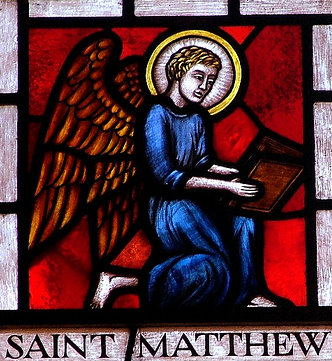
St Matthew

.

Matthew was originally a tax-gatherer, in the service of the Romans who became one of the twelve Apostles and the author of the first Gospel. He is spoken of five times in the New Testament; first in Matthew 9: 9, when called by Jesus to follow Him, and then four times in the list of the Apostles, where he is mentioned in the seventh (Luke 6: 15, and Mark 3: 18), and again in the eighth place (Matthew 10: 3, and Acts 1: 13). The man designated in Matthew 9: 9, as "sitting in the custom house," and "named Matthew" is the same as Levi, recorded in Mark 2: 14, and Luke 5: 27, as "sitting at the receipt of custom." The account in the three Synoptics is identical, the vocation of Matthew-Levi being alluded to in the same terms. Hence Levi was the original name of the man who was subsequently called Matthew; the Maththaios legomenos of Matthew 9: 9 would indicate this.

The fact of one man having two names is of frequent occurrence among the Jews. It is true that the same person usually bears a Hebrew name such as "Shaoul" and a Greek name, Paulos. However, we have also examples of individuals with two Hebrew names as, for instance, Joseph-Caiaphas, Simon-Cephas etc. It is probable that Mattija, "gift of Iaveh," was the name conferred upon the tax-gatherer by Jesus Christ when He called him to the Apostolate, and by it he was thenceforth known among his Christian brethren, Levi being his original name.

Matthew, the son of Alpheus (Mark 2: 14) was a Galilean, although Eusebius informs us that he was a Syrian. As tax-gatherer at Capharnaum, he collected custom duties for Herod Antipas, and, although a Jew, was despised by the Pharisees, who hated all publicans. When summoned by Jesus, Matthew arose and followed Him and tendered Him a feast in his house, where tax-gatherers and sinners sat at table with Christ and His disciples. This drew forth a protest from the Pharisees whom Jesus rebuked in these consoling words: "I came not to call the just, but sinners".

No further allusion is made to Matthew in the Gospels, except in the list of the Apostles. As a disciple and an Apostle he thenceforth followed Christ, accompanying Him up to the time of His Passion and, in Galilee, was one of the witnesses of His Resurrection. He was also amongst the Apostles who were present at the Ascension, and afterwards withdrew to an upper chamber, in Jerusalem, praying in union with Mary, the Mother of Jesus, and with his brethren (Acts 1: 10 and 1: 14).

Of Matthew's subsequent career we have only inaccurate or legendary data. St. Irenæus tells us that Matthew preached the Gospel among the Hebrews, St Clement of Alexandria claiming that he did this for fifteen years, and Eusebius maintains that, before going into other countries, he gave them his Gospel in the mother tongue. Ancient writers are not as one as to the countries evangelized by Matthew, but almost all mention Ethiopia to the south of the Caspian Sea (not Ethiopia in Africa), and some Persia and the kingdom of the Parthians, Macedonia, and Syria.

According to Heracleon, who is quoted by Clement of Alexandria, Matthew did not die a martyr, but this opinion conflicts with all other ancient testimony. The account of his martyrdom in the apocryphal Greek writings entitled "Martyrium S. Matthæi in Ponto" and published by Bonnet, "Acta apostolorum apocrypha" (Leipzig, 1898), is absolutely devoid of historic value. Lipsius holds that this "Martyrium S. Matthæi," which contains traces of Gnosticism, must have been published in the third century.
There is a disagreement as to the place of St Matthew's martyrdom and the kind of torture inflicted on him, therefore it is not known whether he was burned, stoned, or beheaded. The Roman Martyrology simply says: "S. Matthæi, qui in Æthiopia prædicans martyrium passus est."

Various writings that are now considered apocryphal, have been attributed to St Matthew. In the "Evangelia apocrypha" (Leipzig, 1876), Tischendorf reproduced a Latin document entitled: "De Ortu beatæ Mariæ et infantia Salvatoris," supposedly written in Hebrew by St Matthew the Evangelist, and translated into Latin by Jerome, the priest. It is an abridged adaptation of the "Protoevangelium" of St James, which was a Greek apocryphal of the second century. This pseudo-Matthew dates from the middle or the end of the sixth century.

The Latin Church celebrates the feast of St Matthew on September 21st, and the Greek Church on November 16th. St Matthew is represented under the symbol of a winged man, carrying in his hand a lance as a characteristic emblem.
.
.

Saturday, 23 April 2011

Resurrection

.

He is not here, for He is risen, as He said. Come, and see the place where the Lord was laid.

(Matthew 28: 6)
.

Friday, 22 April 2011

Crucifixion

.

Some of the Jewish leaders hated Jesus because He condemned their sins. They did not want to believe the truth He preached, as He urged them to repent and turn back to God. They became jealous of the great crowds that followed Him and believed in Him, and finally decided to get rid of Him by having Him killed.

Since the Jews did not have the right to have a man killed without the approval of the Roman governor, they had to take Jesus to Pilate. At the trial they had no evidence of wrong-doing by Jesus, but put enough pressure on Pilate that he finally agreed to have the soldiers kill Jesus by crucifying Him.

The place where they killed prisoners was outside the city of Jerusalem on a small hill called Golgotha or the place of the skull. Here they laid the cross on the ground while they nailed his hands and feet to it with great spikes. The cross was then lifted and dropped into a hole in the ground. The entire weight of the body tore at the spikes, and the pain was almost beyond endurance. The blood began to pound through the body as the shock of what was happening began to take its toll. As the cells of the body were broken down it became a living death that sometimes lasted for a few hours, and could even last for a few days. Since Jesus had been whipped before they took Him to be crucified, He was already weak from loss of blood. Mercifully, He lived only a few hours on the cross.

Even with all the pain, Jesus thought of others rather than Himself. His first words from the cross were, "Father, forgive them for they know not what they do." Even though He could have threatened to punish them eternally when they faced Him in judgement, he did not do so. He thought of His mother, who stood by the cross weeping, and asked his beloved friend John to take care of her. On either side of Him there were two thieves crucified with Him. When one of them expressed faith in Jesus, the Saviour answered, "Today shalt thou be with Me in paradise." As the terrible afternoon wore on and His pain increased he finally moaned, "I thirst," and was offered vinegar, which He would not drink. God blotted out the sun as if to let us know how black the deed which was being done, and out of that blackness Jesus cried, "My God, My God, why hast Thou forsaken me?" His final words expressed his complete surrender to the will of God as He said, "It is finished; Father into Thy hands I commend my spirit." He then bowed His head and died.

Even the earth could not accept the death of its Creator and Master without showing grief. There was a great earthquake which shook the countryside and made all people afraid. The only fear which we need to have, however, is that of refusing the love He showed in dying for us. The theme of our lives ought to be, "I'll live for Him who died for me, how happy then my soul shall be. I'll live for Him who died for me, my Saviour and my God."
.

Thursday, 21 April 2011

Betrayal

.

"The Son of Man will go just as it is written about him. But woe to that man who betrays the Son of Man" (Matthew 26: 24; Mark 14: 21)


Betrayal is something most of us will suffer at some time in life, and often it is difficult to understand why it happens. Jesus first predicted Judas' betrayal by quoting Psalm 41: 9: "He who shares my bread has lifted up his heel against me."

During supper, Jesus said: "I have eagerly desired to eat this Passover with you before I suffer. For I tell you, I will not eat it again until it finds fulfillment in the kingdom of God."


Jesus took a cup, gave thanks and said: "Take this and divide it among you. For I tell you I will not drink again of the fruit of the vine until the kingdom of God comes."

Jesus took bread, gave thanks and broke it, and gave it to the disciples, saying: "Take it and eat; this is my body given for you. Do this in remembrance of me."

After supper, he took the cup, gave thanks and offered it to the disciples, saying: "Drink from it, all of you. This is my blood of the covenant, which is poured out for many for the forgiveness of sins. I tell you, I will not drink of this fruit of the vine from now on until that day when I drink it anew with you in my Father's kingdom." 

Jesus then said: "The hand of him who is going to betray me is with mine on the table."


The disciples were sad, and each asked him: "Surely not I?"

"It is one of the Twelve," he replied, "one who dips bread into the bowl with me. The Son of Man will go just as it is written about him. But woe to that man who betrays the Son of Man! It would be better for him if he had not been born."

John, at Peter's urging, asked Jesus who would betray him. Jesus responded: "It is the one to whom I will give this piece of bread when I have dipped it in the dish." He dipped the bread and gave it to Judas.


Judas took it and asked, "Surely not I, Rabbi?" At this point, Satan entered him.

Jesus answered, "Yes, it is you." Then Judas left.

“What will you give me if I deliver Him over to you?” And they paid him thirty pieces of silver. (Matthew 26: 15)

When we are betrayed by someone thought to be a friend and spiritual brother we should contemplate the betrayal suffered by Christ. Jesus experienced a most bitter betrayal by one of His closest friends. Psalm 55 encapsulates the sharpness of that betrayal in two stanzas: "If this had been done by an enemy I could bear his taunts. If a rival had risen against me, I could hide from him. / But it is you, my own companion, my intimate friend! How close was the friendship between us. We walked together in harmony in the house of God." Judas Iscariot, who had been chosen by God to be one of the twelve Apostles betrayed the Lord to His death. The full drama of human weakness and evil surrounded Christ in the paschal mystery, but He continued to love and to intercede for our salvation. That drama continues throughout history, but so does the love of God given to us in the Eucharist. Not only does the Eucharist remind us of that love, but more importantly, it is that Love which has the power to conquer all sin and darkness.

.

Sunday, 17 April 2011

Palm Sunday

.


Rejoice greatly, O daughter of Sion, shout for joy, O daughter of Jerusalem: BEHOLD THY KING will come to thee, the just and saviour: he is poor, and riding upon an ass, and upon a colt the foal of an ass. And I will destroy the chariot out of Ephraim, and the horse out of Jerusalem, and the bow for war shall be broken: and he shall speak peace to the Gentiles, and his power shall be from sea to sea, and from the rivers even to the end of the earth.

Zacharias 9: 9-10
.

Thursday, 1 July 2010

The Most Precious Blood

.

Sanguis Christi, inebria me!

July 1st is the Solemnity of the "Most Precious Blood of Our Lord Jesus Christ." This feast, celebrated in Spain in the 16th century, was later introduced to Italy by Saint Gaspar del Bufalo and extended to the whole Church by Pius IX. The Feast of the the Most Precious Blood of Our Lord Jesus Christ exists in the Ordinary Form of the Roman Rite as a Votive Mass. It commemorates all of the times Our Lord shed His most precious blood: the Circumcision, the Agony in the garden, the Scourging at the pillar, the Crowning with thorns, and in the Crucifixion. This feast was instituted only in 1849, but the devotion is as old as Christianity. The early Fathers say that the Church was born from the pierced side of Christ, and that the Sacraments were brought forth through His Blood. The special beauty of this feast is its focusing our attention directly on the Blood of Christ, a short cut to the heart of revelation. In these days we need to think of the Passion of Christ; we do not know how God is going to test us. Devotion to the Precious Blood is a fundamental, sane approach to God. It is hard and painful; it will help us to steel our own hearts against weakness. The Feast of Corpus Christi and the Feast of the Most Precious Blood were combined in 1970, becoming the Solemnity of the Most Holy Body and Blood of Christ. Until then, separate feasts existed for the Body of Christ, held on the Thursday after Trinity Sunday, and the Most Precious Blood of Our Lord Jesus Christ, with a feast on July 1st. Some groups continue to use the earlier forms of the Roman Rite and the corresponding calendars, ie General Roman Calendar of 1962 and General Roman Calendar of 1954. 

May His Blood spring up within us as a saving water for eternal life.
.